 English
 Português
International Day of Women and Girls in Science: Women’s Presence at the LNCC Artificial Intelligence Institute
Feb, 11 2026
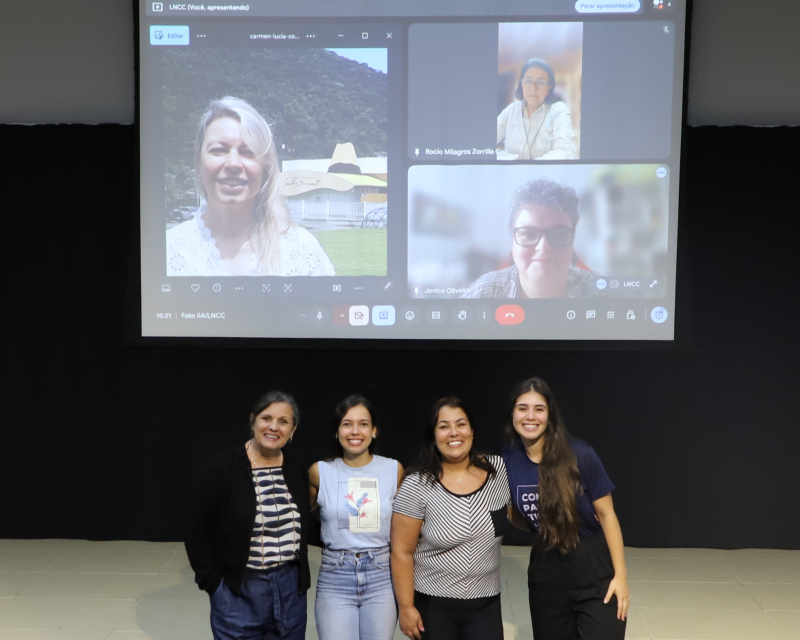
The International Day of Women and Girls in Science, celebrated on February 11, highlights the importance of gender equity for scientific and technological advancement. At the Artificial Intelligence Institute of the National Laboratory for Scientific Computing (IIA/LNCC), this date reinforces a concrete commitment to diversity, reflected in its scientific work.
For researcher Carmen Bonifácio, her interest in science began in childhood, driven by curiosity to explore in depth the topics presented in the classroom. This motivation led her to scientific research, the field in which she works today at the IIA. According to her, “it is rewarding to know that our work somehow helps drive society’s progress.” Carmen also emphasizes that women’s presence is essential in all sectors and recalls that, throughout history, women ahead of their time have made fundamental contributions to science.
The Institute’s work also focuses on training new generations and expanding access to science, especially through scientific Olympiads. Doctoral candidate Gabriela Moraes Botaro, a researcher at IIA-LNCC and responsible for the Institute’s institutional support for the National Artificial Intelligence Olympiad (ONIA), highlights that these initiatives play a decisive role in bringing girls and young women closer to science and artificial intelligence. For her, “Olympiads spark enthusiasm, open doors, and broaden horizons, allowing girls to dream big and see themselves as future scientists.”
Gabriela’s own trajectory illustrates this impact. Her first contact with a federal university occurred through scientific Olympiads, and her participation in programs such as OBMEP and PICME Júnior was decisive in her education, paving the way for her academic journey. She also emphasizes that remaining in research at advanced levels involves significant challenges, especially in a context still marked by gender inequalities. “For many women, staying in science despite these challenges is also an act of resistance and, at the same time, a way to open paths and inspire others who are just beginning their journey,” she states.
Researcher Jonice Oliveira, a member of the LNCC AI Institute, professor at UFRJ, and coordinator of Lab Cores, also notes that challenges evolve throughout one’s career. According to her, although she had strong academic and professional references, there were few women in those spaces—though all were remarkable. The greatest challenge, she reports, arose when she took on management and leadership roles. “I had to assert my voice, my place, and my choices, because culturally it was not yet common for women to occupy different leadership positions. I am happy to see that this reality is changing,” she says.
Addressing girls and young women who are beginning their journeys, Jonice reinforces the importance of self-confidence and respecting one’s own process. “Do not compare yourself—people with the same destination take different routes. Insecurity is part of the journey, but it cannot define your steps. Science needs your perspective—and your path may be more powerful than you imagine at the beginning,” she advises.
The diversity of perspectives is also highlighted as an essential element for the quality of scientific research. For researcher Rocio Zorrilla, women’s presence in science is directly related to optimizing talent. “Science is a rigorous pursuit; for research to progress, we cannot afford to leave capable minds out,” she emphasizes. In her work, Rocio observes that different backgrounds and viewpoints contribute to more robust, creative, and precise solutions, strengthening scientific production in areas such as STEM—Science, Technology, Engineering and Mathematics—and artificial intelligence.
Beyond research, women’s leadership at the IIA extends to management, science communication, and institutional articulation. The Institute’s project and science communication manager, Anmily de Paula Martins, highlights that women’s presence in strategic positions contributes to more collaborative, inclusive, and interdisciplinary approaches, especially in complex and constantly evolving fields such as artificial intelligence. In this context, she notes that “female representation also plays an important role in inspiring new generations,” expanding opportunities for girls and young women in science.
Along the same lines, Tathiana Tapajóz, who works in outreach, administration, and events at the Institute, underscores the importance of scientific events as tools for bringing science closer to society. “Scientific events connect science with society, showing how science impacts the daily lives of citizens, fostering interest, knowledge exchange, and social engagement,” she states.
This connection between science and the public is also emphasized by Graziele Loreti, who works in institutional communication and outreach at the IIA. According to her, “giving visibility to scientific work carried out by women is a way to strengthen science, inspire new trajectories, and show that these spaces are diverse, accessible, and possible.”
The coordinator of the LNCC Artificial Intelligence Institute, Fabio Porto, emphasizes that gender diversity directly contributes to scientific excellence and the development of more innovative and socially relevant solutions. “At the IIA, we work to consolidate an environment that values different trajectories and encourages girls and young women to see science and artificial intelligence as strategic fields for the country’s future,” he states.
IIA Outreach Office
instituto.ia@lncc.br
Other News
International Cooperation: IIA-LNCC Presents the Gypscie System at a Seminar at the LIG Laboratory of Université Grenoble Alpes
Rio de Janeiro Hosted the GPAI Innovation Workshop 2026 and Strengthened Brazil’s Leadership in Global Artificial Intelligence Discussions